

The Thursday Night Football showdown between the various Cleveland Browns and the New York Jets highlighted a smooth evaluation in form among the 2 teams. Cleveland took control early, with a robust offensive display that quickly put the Jets on the returned foot. The Browns’ balanced assault of specific passing and effective rushing helped them dominate ownership, placing the tone for a 37-20 victory that secured their postseason spot.
Quarterback Joe Flacco led the way with sharp passing and smart preference-making, connecting on key throws that energized the Browns’ offense. The tight prevent institution also stood out, generating ancient contributions with large plays that always moved the chains and created scoring possibilities. Defensively, Cleveland remained competitive, pressuring the Jets’ quarterback and stopping any sustained drives, ensuring the early lead remained intact.
Looking at the Cleveland Browns vs New York Jets match player stats, the numbers replicate the crew’s dominance on both facets of the ball. The Browns’ explosive plays, efficient passing, and tight give up manufacturing combined with sturdy protective stops spotlight why Cleveland controlled the game from beginning to completion. For fans reading participants’ typical overall performance, this sport provided clean insights into who made the biggest effect and why the Browns secured a decisive win.
The Quarterback Duel: Joe Flacco’s Dominance vs Trevor Siemian’s Challenges
The story of the Cleveland Browns vs New York Jets match player stats starts with the quarterbacks. Joe Flacco, dealing with his former team, delivered a unique overall performance that set the tone for Cleveland’s victory. The veteran signal-caller completed 19 of 29 passes for 309 yards, threw three touchdowns, and had just one interception. What stood out most became that almost all of this production came within the first half of. Flacco systematically dissected a Jets secondary that had previously held some of the league’s top quarterbacks in check, highlighting his enjoyment and instruction.
Flacco’s capacity to push the ball downfield made a primary difference. He averaged 10.7 yards per attempt, displaying that Cleveland’s passing recreation wasn’t pretty much brief, safe throws. Deep passes, flawlessly timed throws to open receivers, and accurate pocket presence allowed playmakers to turn opportunities into explosive gains. Browns head coach Kevin Stefanski praised his quarterback, saying, “Flacco’s vision and calm within the pocket let our offense operate at a degree that few defenses can manage. He gives our players the gap they need to make large performances.”
On the other facet, Trevor Siemian had a much harder nighttime. Tasked with navigating Cleveland’s pinnacle-ranked protection, he completed 32 of forty five attempts for 261 yards, one landing, and one interception. While the final touch rate appeared solid, lots of Siemian’s yards came late in the game or on quick, conservative passes to strolling returned Breece Hall. From the first snap, the Browns’ skip rush disrupted his timing, forcing hurried throws and restricting his potential to make “Big Time Throws.” The distinction in quarterback performance became a key issue inside the final rating, clearly reflected in the Cleveland Browns vs New York Jets match player stats.
See also “Bengals vs Green Bay Packers Match Player Stats: Full Game Recap“
Receiving Corps Spotlight: David Njoku’s Career-Defining Performance
Another highlight inside the Cleveland Browns vs New York Jets match player stats changed into tight give up David Njoku, who had one of the most brilliant video games of his career. Njoku caught 6 passes for 134 yards, averaging an extraordinary 22.Three yards in step with reception. His overall performance turned into now not just about catching the ball however also creating vast yardage after the trap. Short passes regularly changed into the most important profits to Njoku’s pace, agility, and vision on the sector.
Njoku’s capacity to stretch the sector vertically and open up space within the purple zone gave Cleveland a clean advantage. Jets defenders struggled to suit his athleticism, mainly due to several key scoring plays that widened the space. Beyond his physical capabilities, Njoku’s cognizance in locating gentle spots in the defense changed into evident for the duration of the sport. This aggregate of athleticism, path jogging, and YAC made him virtually untouchable and a central piece of Cleveland’s offensive method.
His standout sport now not simplest highlighted his man or woman expertise however also emphasised the effectiveness of Cleveland’s offensive scheme, which created opportunities for playmakers to take advantage of protecting mismatches. Njoku’s contribution turned into a main motive the Browns’ passing game thrived, and it’s absolutely meditated within the particular Cleveland Browns vs New York Jets match player stats.
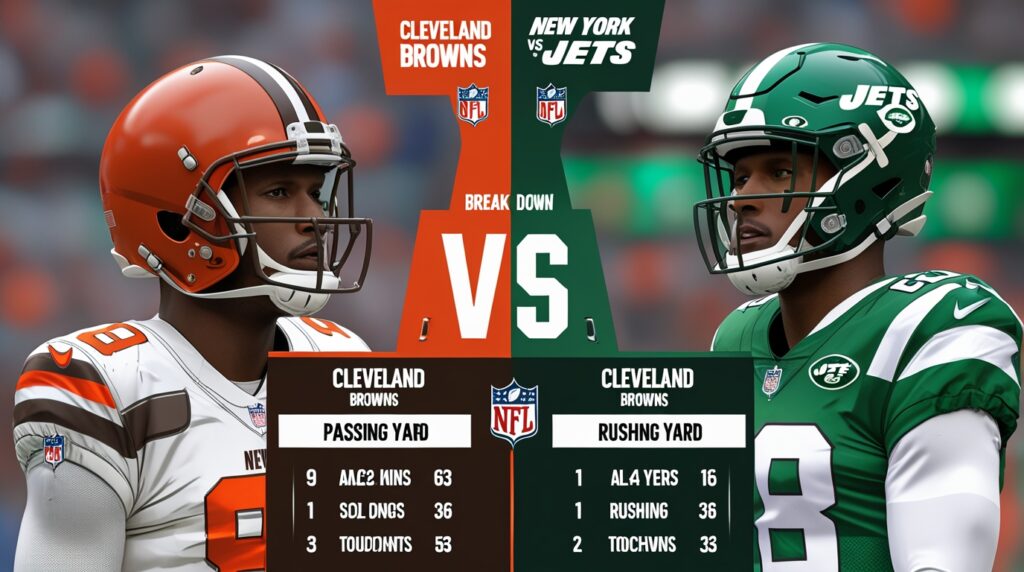
Key Receiving Statistics: Njoku Leads the Way
In the Cleveland Browns vs New York Jets match player stats, the receiving endeavor changed into dominated by using Cleveland’s tight end David Njoku. Njoku hauled in 6 receptions for 134 yards, with a protracted gain of 43 yards. While he didn’t score a touchdown, his potential to continuously create massive performances after the seizure stored the Jets’ protection on its heels sooner or later of the number one 1/2 of. Njoku’s size, tempo, and location recognition allowed him to show routine passes into recreation-changing yardage, making him the focus of Cleveland’s passing assault.
Wide receiver Elijah Moore moreover made an impact earlier than exiting with a concussion. Moore finished with five receptions for 61 yards and one landing. His eight-outdoor rating highlighted the short connection he has developed with quarterback Joe Flacco, illustrating the timing and chemistry that made Cleveland’s quick passing undertaking so powerful.
Jerome Ford, whilst in maximum cases a strolling again, contributed substantially as a receiver in important conditions. He caught 2 passes for 31 yards, every of which have been touchdowns. His potential to find openings inside the red vicinity and quit drives correctly modified into a first-rate difficulty in Cleveland changing scoring opportunities into factors.
On the Jets’ aspect, Garrett Wilson struggled closer to Cleveland’s protective schemes. Targeted 10 instances, he controlled the handiest 50 receiving yards and modified into not able to find out the give up sector. The Browns effectively used press-man coverage mixed with bracket insurance to limit Wilson’s potential to make deep plays, displaying how disciplined protecting making plans can neutralize even elite expertise.
Breece Hall served as the Jets’ number one receiving alternative out of the backfield, catching nine passes for eighty two yards and one touchdown. Hall’s versatility allowed him to be a safety valve for quarterback Trevor Siemian, even though the Browns’ protective pressure restricted the overall explosiveness of New York’s aerial assault.
The Ground Game: Breece Hall vs Jerome Ford
While passing dominated the narrative, the rushing struggle supplied insight into every crew’s approach. For the Jets, Breece Hall remained the using pressure of their offense. Despite a suffering offensive line, Hall received 84 yards on thirteen carries, with a longer term of 25 yards. When mixed with his 82 receiving yards, Hall accounted for 166 of New York’s 367 general offensive yards, demonstrating his significance to the Jets’ game plan. His 6.5 yards consistent carry stood out as an extraordinary shiny spot on an otherwise challenging day out.
For Cleveland, Jerome Ford turned into a flexible weapon who impacted both the walking and passing games. He carried the ball 12 times for sixty four dashing yards, that specialize in efficiency instead of sheer extent. Where Ford definitely made his mark came in the purple region, catching touchdown passes, together with a standout play in which he maneuvered through a couple of defenders to reach the cease region. Cleveland’s balanced approach between speeding and passing kept the Jets’ defenders guessing and limited their capacity to use steady stress on Flacco.
Overall, the Cleveland Browns vs New York Jets match player stats spotlight how Cleveland’s combination of explosive receiving, strategic rushing, and disciplined defense created a triumphing system. Meanwhile, the Jets’ offensive production relied closely on Breece Hall’s dual-threat capacity, however it became no longer enough to triumph over the Browns’ manipulation on both sides of the ball.
Rushing Performance Metrics: Hall and Ford Lead Their Teams
The speeding recreation played a key role within the Cleveland Browns vs New York Jets match player stats, highlighting how every group applied their backs in a different way. For the Jets, Breece Hall carried the offense on his shoulders, recording thirteen rushes for eighty four yards, averaging an excellent 6.Five yards consistent with bring. Hall’s speed and vision allowed him to consistently find seams, giving New York a dependable option to supplement their passing sport. He also contributed to the receiving game, further demonstrating his dual-risk functionality.
On Cleveland’s aspect, Jerome Ford showcased efficiency and flexibility. Ford totaled sixty four speeding yards on 12 includes, averaging five.Three yards in line with try. While his overall yardage was modest in comparison to Hall, Ford’s effect got here in crucial conditions, in particular in maintaining drives and keeping the protection guessing. Kareem Hunt additionally chipped in with 10 carries for 31 yards and a touchdown, offering brief-yardage and crimson-region reliability. Even quarterback Joe Flacco contributed every now and then, consisting of an eight-yard scramble, emphasizing the Browns’ balanced offensive method.
Cleveland’s speeding attack targeted the developing area, mixing internal runs with out of doors alternatives, and preserving New York’s shielding front off-stability. In assessment, the Jets leaned closely on Hall to generate explosive plays, but the Browns’ disciplined front seven restricted lengthy gains and minimized opportunities for momentum-transferring runs.
Defensive Dominance and Special Teams Impact
No discussion of the Cleveland Browns vs New York Jets match player stats is probably whole without highlighting Cleveland’s protective performance. The Browns’ defense, anchored by Myles Garrett, carried out consistent pressure at some point of the sport. While the sack totals weren’t overwhelming, the effectiveness of the pass rush compelled Trevor Siemian into making quick decisions, disrupting the rhythm of the Jets’ passing attack.
A turning factor got here inside the first zone at the same time as protection Ronnie Hickman intercepted Siemian and once more it 30 yards for a touchdown. These choose-six not best located factors on the board however moreover set the intellectual tone for the relaxation of the game. Hickman reflected on the play, saying, “We communicated approximately by taking the ball away and scoring. When you’ve got a protecting front like ours, the possibilities for the secondary are going to be there. I simply needed to execute.”
Special teams additionally contributed with the resource of maintaining area function and proscribing the Jets’ probabilities for huge returns, complementing Cleveland’s defensive strain. Overall, the combination of calculated rush safety, well timed interceptions, and strategic pressure highlights why the Browns were able to manipulate the game from start to finish.
Together, those performances underline how Cleveland’s multi-dimensional sport plan—mixing effective rushing, green passing, and opportunistic protection—created a dominant display reflected inside the particular Cleveland Browns vs New York Jets match player stats.
Defensive Leaders: Cleveland’s Pressure and Game-Changing Plays
The protective average typical overall performance in the Cleveland Browns vs New York Jets match player stats grow to be a decisive hassle in the very last results. Cleveland’s protection Ronnie Hickman made a big impact with 2 tackles, an interception, and a 30-out-of doors pick-six that swung momentum early in the sport. His play set the tone for a safety that continuously compelled the Jets and created turnovers.
Linebacker Sione Takitaki led the Browns with 16 conventional tackles, showcasing his capability to study the play and make stops everywhere in the place. Meanwhile, on the Jets’ aspect, Quincy Williams recorded 8 tackles, 1 sack, and a deal with for loss, and Jermaine Johnson contributed 15 sacks and three quarterback hits, reflecting New York’s sporadic protective pressure.
Special organizations moreover recommended the sport. The Jets managed to dam a topic, trying to benefit from unique yardage at the bypass decrease again, one of the few moments in which they threatened to shift momentum. However, Cleveland’s kicking unit, lacking normal kicker Dustin Hopkins, struggled with consistency, a minor setback in an otherwise dominant modern day overall performance at some stage in offense and protection.
Historical Significance and Playoff Implications
Beyond character performances, the game had sizable implications for each franchise. With this victory, the Browns reached 11 wins and secured their 2nd playoff appearance on account of 2020. Joe Flacco’s passing show was historic, making him the primary quarterback in NFL history to record four consecutive games with 300 passing yards against the equal opponent—the Jets—at the same time as playing for distinct teams. His resurgence transformed Cleveland from a team closely reliant on defense right into a balanced, high-performing squad.
For New York, the Cleveland Browns vs New York Jets match player stats mirror a crew that struggled to capitalize on possibilities. Despite having a defense presenting standout gamers like Sauce Gardner and Quinnen Williams, the Jets’ offense couldn’t sustain drives continually. Interestingly, the Jets held the ball longer, with a 32:45 time of ownership as compared to Cleveland’s 27:15. However, the Browns’ performance changed into unrivaled, converting almost every first-1/2 possession into factors and leaving New York not able to mount a sustained comeback.
Overall, these stats underline how Cleveland combined explosive offense, opportunistic defense, and strategic efficiency to manipulate the sport, at the same time as the Jets’ overlooked chances and lack of offensive concord averted them from keeping tempo.
Conclusion
The cleveland browns vs new york jets match player stats show a crew firing on all cylinders. Joe Flacco led the offense with sharp, efficient passing, while David Njoku and Jerome Ford created explosive plays that saved the Jets’ protection off balance. Cleveland’s balanced attack mixed strategic dashing and specific passing to govern possession and maintain drives.
Defensively, the Browns set the tone early. Ronnie Hickman’s pick-six and the relentless strain from Myles Garrett and the front seven compelled turnovers and constrained New York’s opportunities. The institution’s disciplined safety and well timed plays ensured Cleveland maintained control regardless of the truth that the Jets had extended drives.
For the Jets, the stats mirror unnoticed possibilities. Breece Hall supplied a twin-danger opportunity, but New York struggled to keep offensive rhythm notwithstanding a sturdy defensive unit. Overall, Cleveland’s overall performance, intensity, and execution across all tiers of the game secured a decisive 37-20 win and strengthened their fame as a playoff-ready group.
FAQs
1. Who led the Cleveland Browns in passing against the Jets?
Joe Flacco became the standout quarterback for Cleveland, completing 19 of 29 passes for 309 yards, 3 touchdowns, and one interception. His early dominance inside the first 1/2 helped set the tone for the Browns’ 37-20 victory.
2. Which players made the biggest impact in the receiving game?
David Njoku led Cleveland with 6 receptions for 134 yards, at the identical time as Jerome Ford contributed 2 receiving touchdowns. For the Jets, Breece Hall and Garrett Wilson have been number one dreams, irrespective of the reality that Wilson has ended up restricted to 50 yards because of Cleveland’s protecting schemes.
3. How did the rushing attack compare between the two teams?
Breece Hall carried the Jets with 13 rushes for 80 4 yards, averaging 6.Five yards everyday with supply. Cleveland’s Jerome Ford had 12 carries for sixty four yards, while Kareem Hunt delivered 31 yards and a touchdown. Cleveland focused on balanced critical normal average overall performance, at the same time due to the reality the Jets relied carefully on Hall’s twin-risk capability.
4. Which defensive players stood out in the game?
Ronnie Hickman ended up Cleveland’s protecting superstar, recording an interception once more for a touchdown. Sione Takitaki led the organization with 16 tackles. For the Jets, Quincy Williams and Jermaine Johnson made key contributions with tackles and sacks, despite the reality that their safety couldn’t save Cleveland’s scoring drives.
5. What were the playoff implications of this game?
Cleveland’s 37-20 win secured their 2d playoff appearance for 2020. Joe Flacco’s historical overall performance additionally made him the number one quarterback in NFL statistics to file four consecutive games with 300 passing yards toward the equal opponent even as gambling for one-of-a-type groups. The Jets’ loss highlighted unnoticed possibilities and the want for extra offensive consistency.
Read more about Sports At Phrasecave