
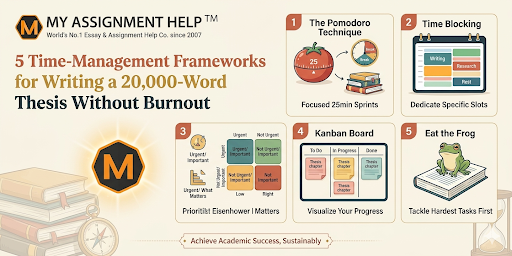
A 20,000-word thesis is often the most significant and intimidating document an Australian postgraduate student will ever produce. It’s not just the sheer volume of words that’s daunting; it’s the required depth of research, critical analysis, and original contribution. Managing this immense workload while maintaining your mental wellbeing, often alongside work and family commitments, is a balancing act of the highest order. The spectre of burnout is real.
Burnout, a state of emotional, physical, and mental exhaustion caused by excessive and prolonged stress, is a common affliction among postgraduate researchers. A 2023 study published in Higher Education Research & Development found that over 40% of Australian PhD candidates reported significant levels of stress and anxiety, with time pressures and workload cited as major contributors (University of South Australia, 2023). This statistic highlights the critical need for robust, evidence-based time-management strategies that prioritize health as much as productivity.
Recognizing the symptoms early is key. When the pressure mounts, it’s natural to feel overwhelmed. You might find yourself thinking, “This is too much; can someone do my assignment for me?” While seeking support is wise, true mastery comes from managing the process. It’s not about finding more hours; it’s about making the hours you have count. By adopting structured frameworks, you can transform this monumental task into a series of manageable, even enjoyable, challenges. These methods aren’t quick fixes; they are sustainable workflows designed to protect your energy while ensuring consistent, high-quality output.
For those in niche fields or specific vocational sectors, such as community services, the challenge is amplified. The unique demands of assessments in these areas require dedicated focus. If you are a student working through a particular unit, you can find tailored support and resources, such as specialized chcdiv001 Assessment Answers, which can free up critical mental space for your broader thesis work. This allows you to delegate components when appropriate, ensuring every assessment is handled efficiently.
The Infographic: Your Thesis Time-Management Roadmap
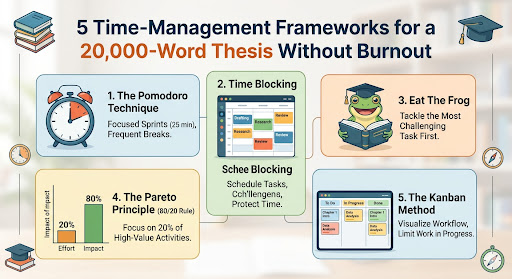
The following infographic illustrates the five frameworks discussed in detail below. This visual roadmap provides a quick reference to help you identify which method, or combination of methods, aligns best with your working style.
The 5 Frameworks Explained
1. The Pomodoro Technique
The Concept: Developed by Francesco Cirillo, this framework uses a timer to break work into intervals, traditionally 25 minutes in length, separated by short breaks.
How it applies to a Thesis: A 20,000-word document can feel impossible. But writing for 25 minutes? That’s manageable. Use Pomodoros for highly focused tasks: writing a specific paragraph, analyzing one data set, or editing a single subsection.
Why it Prevents Burnout: It combats cognitive fatigue by enforcing regular, mandatory breaks. It trains your brain to focus and ensures you never work past the point of diminishing returns. The Australian Psychological Society (APS) notes that short, frequent breaks are vital for maintaining concentration and reducing stress (APS, 2022).
2. Time Blocking (or Calendar Blocking)
The Concept: Instead of a simple to-do list, you assign specific ‘blocks’ of time in your calendar for specific tasks. Your calendar becomes your blueprint.
How it applies to a Thesis: You cannot simply ‘work on my thesis.’ You must dedicate 9:00 AM to 11:00 AM on Monday specifically to “Drafting Literature Review on Methodology A.” Guard these blocks religiously.
Why it Prevents Burnout: It reduces decision fatigue. When you know exactly what you are doing and when, you waste zero energy wondering where to start. It also ensures you realistically schedule administrative tasks, data collection, and essential rest periods.
3. Eat The Frog
The Concept: Attributed to Mark Twain, this principle suggests that if you start your morning by eating a live frog, you can go through the day with the satisfaction of knowing that that is probably the worst thing that is going to happen to you. In time management, your ‘frog’ is your hardest, most important task.
How it applies to a Thesis: Identify the one task that you are procrastinating on most—the complex argument, the messy data analysis, the ethical approval form. Do that first, before you check email or do ‘easy’ work.
Why it Prevents Burnout: Procrastination is a major source of anxiety. Tacking your hardest task when your energy is highest (usually morning) eliminates the mental burden of that task hanging over you all day. The sense of achievement is a powerful motivator.
4. The Pareto Principle (80/20 Rule)
The Concept: For many outcomes, roughly 80% of consequences come from 20% of the causes. In work, 20% of your activities produce 80% of your desired results.
How it applies to a Thesis: Identify the high-value 20%: deeply engaging with key theoretical texts, outlining complex arguments, and core writing. The remaining 80% (perfecting citations, minor formatting, exhaustive reading on adjacent topics) often provides less value. Prioritise the 20%.
Why it Prevents Burnout: It forces efficiency. When you realize you don’t need to do everything with the same level of intensity, you reduce your workload without sacrificing quality. It gives you permission to let go of low-value busywork.
5. The Kanban Method
The Concept: A visual system for managing work as it moves through a process. It uses a board (physical or digital, like Trello) with columns like ‘Backlog,’ ‘To Do,’ ‘In Progress,’ and ‘Done.’
How it applies to a Thesis: Break your entire 20,000-word thesis into micro-tasks (e.g., ‘Find 5 papers on X,’ ‘Draft Sec 2.1,’ ‘Analyze interview 3’). Each task gets a card. Visually move the cards across the board. The key is to strictly limit the ‘In Progress’ column (e.g., max 3 cards) to focus flow.
Why it Prevents Burnout: It makes the invisible visible. Seeing the ‘Done’ column fill up provides a palpable sense of progress, which is vital for long-term motivation. Limiting ‘Work In Progress’ prevents you from juggling too many tasks and feeling overwhelmed by simultaneous deadlines.
Conclusion: Sustainable Scholar
A 20,000-word thesis is a marathon, not a sprint. The student who crosses the finish line with a high-quality document and their wellbeing intact is the one who treated the process with respect. By adopting structured time-management frameworks, you transition from being a passive recipient of academic stress to an active, resilient manager of your energy and output. You can achieve distinction without sacrificing your mental health.
Key Takeaways
- Structure is Freedom: Frameworks reduce anxiety and decision fatigue, providing a clear pathway.
- Focus on Energy, Not Time: Protect your peak cognitive hours for high-value tasks.
- Breaks are Non-Negotiable: Regular downtime (as enforced by Pomodoro) is crucial for sustained performance.
- Visualise Progress: Seeing small, consistent wins (via Kanban) is the antidote to the long-term thesis slog.
FAQ
Q: Can I combine these frameworks?
A: Absolutely. Many students use Time Blocking to schedule their week, Eat The Frog to start their day, and The Pomodoro Technique to execute the tasks within their blocked time.
Q: How do I choose the best framework?
A: Experiment. Try one framework for a full week. If you work well in short bursts, start with Pomodoro. If you need a bird’s-eye view of a complex project, start with Kanban.
Q: What if I have data analysis/software I don’t understand?
A: Don’t spend days stuck. Use Time Blocking to allocate specific research/training time. If it’s outside your core capability, explore The Pareto Principle: is mastering this software part of your vital 20%, or can you seek expert support (or simplified tools) to achieve the required 80% outcome?
References
- Australian Psychological Society (APS). (2022). Understanding and managing stress. [online] Available at: https://psychology.org.au/
- University of South Australia (UniSA). (2023). Workplace stress and mental health in the Australian university sector. [online research summary]
- Cicillo, F. (n.d.). The Pomodoro Technique. [online] Available at: https://francescocirillo.com/products/the-pomodoro-technique
About the Author
Dr. Sarah Jensen is a Senior Academic Consultant at MyAssignmentHelp. With a PhD in Organizational Psychology from a top-tier Australian university and over 10 years of experience in postgraduate mentoring, Dr. Jensen specializes in helping students navigate complex research projects, methodology design, and sustainable academic workflows. She is passionate about evidence-based productivity that prioritizes mental wellbeing.
 Backlinks Hub
  James James